Diesel Particulate Filter Explained: DPF Care Without the Jargon
DPF… You might not have given those three letters much thought until they appeared, perhaps on a warning light, a service report, or an unexpected repair bill.
Knowing your modern diesel-engined car has a diesel particulate filter (DPF) fitted is one thing; understanding it is another. You might wonder: What does your DPF do? How does it look after itself? And when should you be concerned?
The job of a diesel particulate filter (DPF) is catching particulate matter (soot) in your exhaust. Regeneration burns trapped soot away at high temperature once the engine and exhaust system reach and maintain suitable conditions. Short journeys are among the most common reasons regeneration stops early; a fault can halt it, and missed cycles leave the filter increasingly restricted.
However, your vehicle’s DPF doesn’t do its job in isolation. As part of your car’s diesel emissions system, it can be affected by other components, which can alter soot levels in the filter or set off warnings that resemble DPF problems.
So we’ll cover those systems briefly as well, giving you a fuller view of what affects your filter.
Throughout this expert guide, you’ll uncover how your DPF cleans itself, the things that can interfere with it, and the everyday habits that help keep it clear.
Why Modern Diesels Need a Diesel Particulate Filter
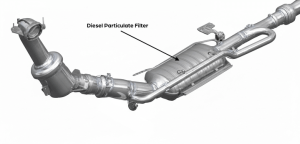
The DPF sits within the exhaust system, where it captures soot before it leaves the vehicle
UK diesel cars have, for the most part, carried a diesel particulate filter as standard since around 2009, the point at which Euro 5 emissions rules made one effectively mandatory. Fitted to the exhaust, the filter holds back soot from the engine that would otherwise leave your car and enter the atmosphere.
Holding back soot has a consequence, though…
Little by little, the filter fills, and unchecked build-up can restrict it. The DPF’s answer is to clean itself, with trapped soot burned away at high temperature once the right conditions are in place, keeping the filter working as it should.
That automatic clean-out, called regeneration, is the idea this whole guide is built around.
September 2016 raised the bar again. Euro 6 standards, covering every diesel car newly registered from that date, brought stricter ceilings for nitrogen oxide (NOx) emissions and particulate matter; a combination of emissions-control systems is how most modern diesel vehicles comply, and the DPF’s key role within it is particulate control.
And one legal point every diesel owner should know: an MOT failure has been a possible outcome of DPF removal, tampering, or emissions-related faults since 2014.
That’s the diesel particulate filter explained. Now for the interesting part: how regeneration works, and what it takes to complete.
How Does a DPF Work? Keeping Itself Clean Through Regeneration
Here’s where it gets clever. Your vehicle’s DPF is built around a honeycomb-like structure, usually made of ceramic, where soot collects while exhaust gases continue on their way.
However, that effectiveness carries a price: the filter steadily fills and can become restricted.
Which raises the obvious question: “How does a DPF work to shed the soot it has collected?” Cleaning is automatic when conditions allow, through a process called regeneration.
There are usually two main regeneration methods:
- Passive regeneration: This occurs naturally when exhaust temperatures remain high enough, for long enough, to burn the accumulated soot away. Sustained high-speed driving is usually where the opportunity arises, without most drivers noticing a thing.
- Active regeneration: The engine management system triggers it after soot in the DPF reaches a set threshold, lifting exhaust temperatures via a range of strategies. The giveaways some drivers spot are a slight change in the engine note or a rise in fuel consumption.
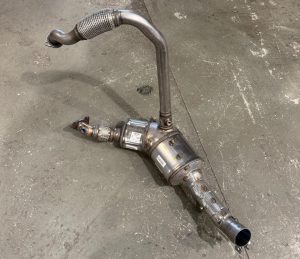
A removed DPF and exhaust assembly ready for inspection and servicing
But there’s a snag to be aware of…
The reality is that an engine switched off mid-regeneration interrupts the process, and some of the trapped soot may stay where it is.
Let that happen again and again, and the build-up can continue; eventually, a DPF warning light may appear.
Neither of the two main regeneration methods can burn accumulated soot away without the vehicle reaching and then maintaining the right operating conditions, and longer regular journeys can make that possible. With the diesel particulate filter explained from the inside, let’s get to the question behind so many DPF problems.
Why a Diesel Needs Longer Runs: The Short-Trip Effect
Understanding “Why does my diesel car need long journeys?” is one of the most useful things a diesel owner can learn.
So what does this mean for you? Everything hinges on what regeneration requires.
A trip to the shops or a school drop-off can finish before the exhaust system reaches the conditions required for regeneration to complete successfully.
Soot left over from one abandoned cycle joins soot from the next; carry on that way, and warnings can eventually surface that need professional attention.
Your vehicle’s DPF requires a specific window of temperature and operating conditions, and that window is more likely to be met and maintained on a longer, continuous journey.
If a DPF warning light is already showing on your vehicle, our experts at South Coast Garage, Eastbourne, can assess your DPF and advise on the next steps.
Beyond the Filter: The Diesel Emissions System and Your DPF
Your DPF operates within your car’s wider diesel emissions system. Consider the EGR (Exhaust Gas Recirculation) valve, which cuts harmful emissions by returning a portion of exhaust gas back into the engine.
Soot and oil vapour leave carbon deposits behind as the months and years pass, and a coated valve can become restricted, slow to respond, or stuck.
What does that have to do with your DPF?
Soot production can increase when the EGR develops a fault, and depending on its nature, this can lead to additional strain on the DPF.
It’s also worth noting that an AdBlue system is likely to be fitted if your diesel vehicle was registered after September 2016.
So what is AdBlue and why does it matter for your diesel emissions?
AdBlue, a fluid injected into the exhaust system, gives the SCR (Selective Catalytic Reduction) catalyst what it needs to convert nitrogen oxides into nitrogen and water vapour.
Your car monitors AdBlue fluid levels and warns you when it’s low; on some vehicles, running out or detecting a system fault can restrict performance or prevent the engine from restarting. These symptoms and DPF warnings can sometimes overlap, so an expert diagnosis may cover both systems.
Spotting the Signs That Your DPF Needs Attention
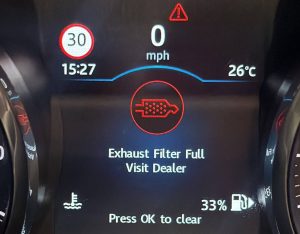
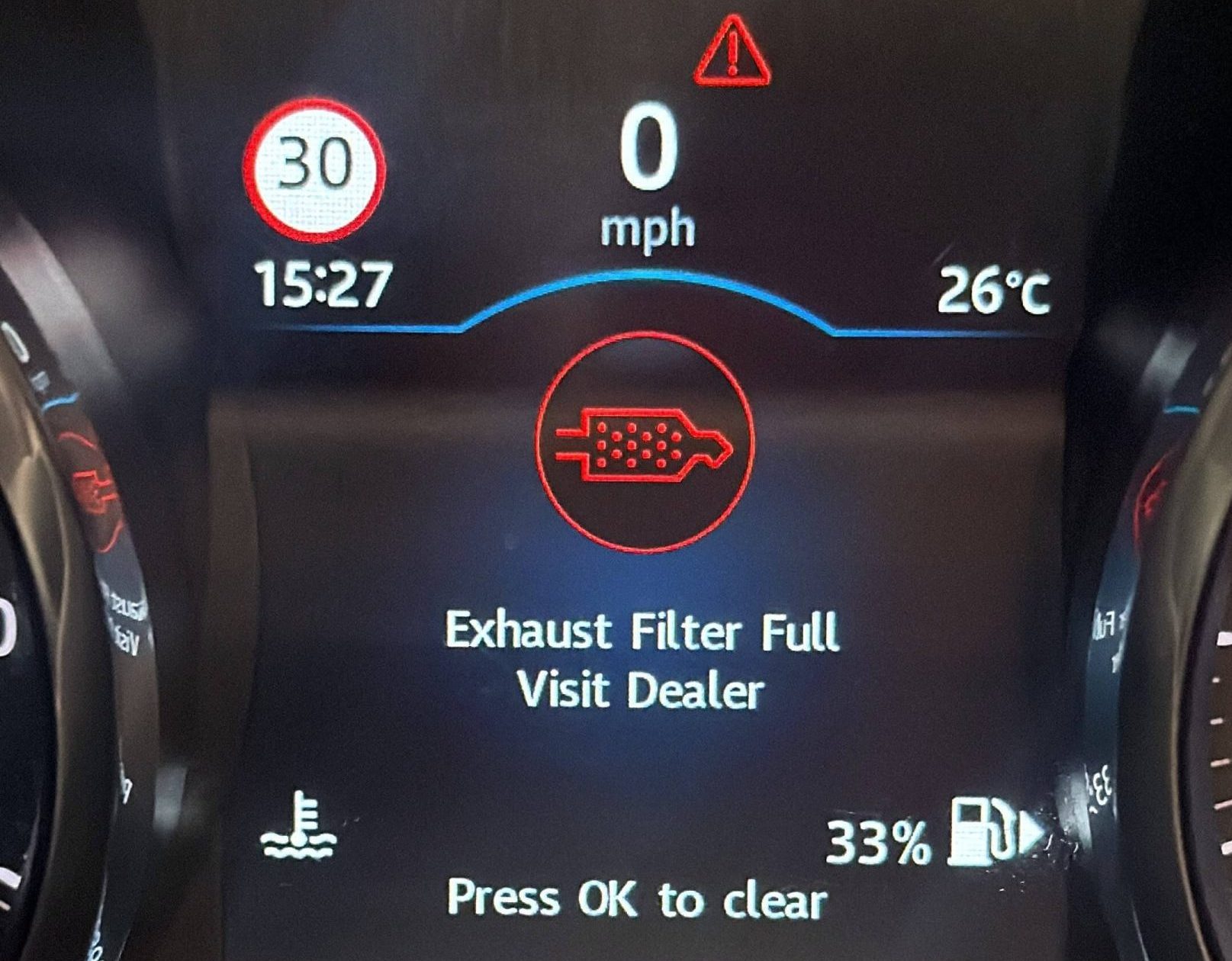
A DPF or exhaust-filter warning should be investigated rather than repeatedly ignored
A DPF fault can be subtle, but your car usually gives you clues:
- DPF warning light on the dashboard: Excessive soot within the filter is one trigger; a fault detected in the DPF, or in the systems that monitor and manage it, is another.
- Reduced engine power or limp mode: If a fault affecting engine operation or emissions control is detected, the engine management system may restrict what the engine can deliver.
- Increased fuel consumption: Extra fuel can go into each attempt to burn away soot, so repeated incomplete regeneration can push usage higher.
- Unusual exhaust smell or visible smoke: A strong smell or anything visible from the exhaust can indicate a fault affecting the engine or emissions system and shouldn’t go unchecked.
Overlap between these symptoms is possible, and the DPF isn’t the source of all of them. Accurate diagnosis comes from an expert’s assessment, because modern vehicles pair the filter with several other systems.
Recognise any of these? Book your DPF in with our experts at South Coast Garage, Eastbourne, for a closer inspection.
Everyday Habits That Protect Your Vehicle’s DPF
The good news? Caring for your vehicle’s DPF asks nothing technical of you. However, these three habits can make a real difference:
- Plan longer journeys where possible: Soot burns away during regeneration only when the engine and exhaust system spend long enough at the right conditions, and a longer, uninterrupted journey provides exactly that.
- Don’t ignore a DPF warning light: Make sure you have any DPF warning light looked at promptly; an undiagnosed issue can worsen, leaving you with a more serious (and expensive) problem.
- Find an expert garage: One component might be flagged by the warning, while the root cause lies elsewhere; finding it requires an expert assessment.
That’s the diesel particulate filter explained, along with how to maintain it; recognising potential issues early should now feel within reach.
Why Choose South Coast Garage for Your DPF in Eastbourne?
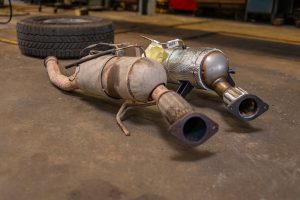
Depending on the fault and condition of the filter, DPF treatment may involve regeneration, cleaning or replacement
Now that you’ve had the diesel particulate filter explained, all that’s left is knowing where to turn if your diesel starts showing symptoms: it pays to have the right garage and experts behind you.
DPF symptoms don’t come with a diagnosis attached…
Many that point towards the filter can stem from faults elsewhere in the diesel emissions system, and what appears to be one DPF fault can sometimes turn out to involve more. An accurate assessment by an expert is needed to know for sure.
Our technicians at South Coast Garage, Eastbourne, put their experience to work with manufacturer-level technology and proven processes behind them, so DPF and emissions-system faults are investigated accurately. When repairs are appropriate, our technicians can carry out DPF-related work, regeneration procedures, cleaning, or replacement, all in accordance with the manufacturer’s repair guidance.
By choosing South Coast Garage, you’ll benefit from:
- An experienced team working with the same technology and reference data as the main dealerships.
- Every repair is covered by a 12-month parts and labour guarantee.
- A courtesy car is available to keep you on the road.
- Experts serving Eastbourne, Brighton, Lewes, and the wider East Sussex area.
Join the {{review-count}} customers who’ve rated us {{average-rating}} stars on Google for expertise, helpful service and excellent value.
Speak to our team on 01323 734473 and book your DPF assessment at South Coast Garage, Eastbourne, today.
Answering Your DPF Questions
What is a diesel particulate filter and why does my car have one?
A DPF is fitted within your diesel vehicle’s exhaust, helping capture particulate matter (soot) before it gets to the atmosphere. Since around 2009, it has been standard on most UK diesel cars, and an MOT failure can result when one has been removed or tampered with.
So, how does a DPF work day to day? Through regeneration, high temperature burns the trapped soot away whenever conditions are right. There are usually two main regeneration methods, passive and active. Passive regeneration occurs when exhaust temperatures remain high enough on their own; the active method is initiated when the engine management system detects soot loading reaching a set threshold.
Why does my diesel car need long journeys to stay healthy?
Soot only burns away when exhaust temperatures suit, and a longer, uninterrupted journey at a steady speed is where your DPF is more likely to find those conditions. Short journeys around town can end the regeneration process before it gets what it needs, allowing soot to accumulate. A fault somewhere in the emissions system can block regeneration as well.
How do I know if my DPF is blocked?
Among the most common signs of a blocked DPF is a DPF warning light on the dashboard. Watch as well for reduced power, increased fuel consumption, or a change in how the engine runs.
None of these signs settles the question by itself, because other issues can produce matching symptoms; having your vehicle assessed is the wise move. Our team at South Coast Garage, Eastbourne, can investigate and advise.
Can a DPF be repaired, or does it need replacing?
Whether a DPF can be repaired rests on the condition of your vehicle’s DPF and the cause of the fault. A restricted DPF can, in many cases, be restored without replacement. Bring your vehicle to our team at South Coast Garage, Eastbourne, for an expert assessment.